THE JAPANESE-INSPIRED AQUARIUM HANDBOOK

Make sense of
your aquarium.

EXPANDED EDITION 3.0 · 386 PAGES

A practical freshwater reference for the moments when you’re unsure what to change, what to buy, or what to leave alone.

Work through 45 practical methods, then apply them with eight complete builds and 36 fish and plant profiles. Keep the companion worksheets beside the tank.

Take a look at the actual pages

Digital handbook & companion files. No subscription.
THE FRESHWATER COLLECTIONEDITION 3.0
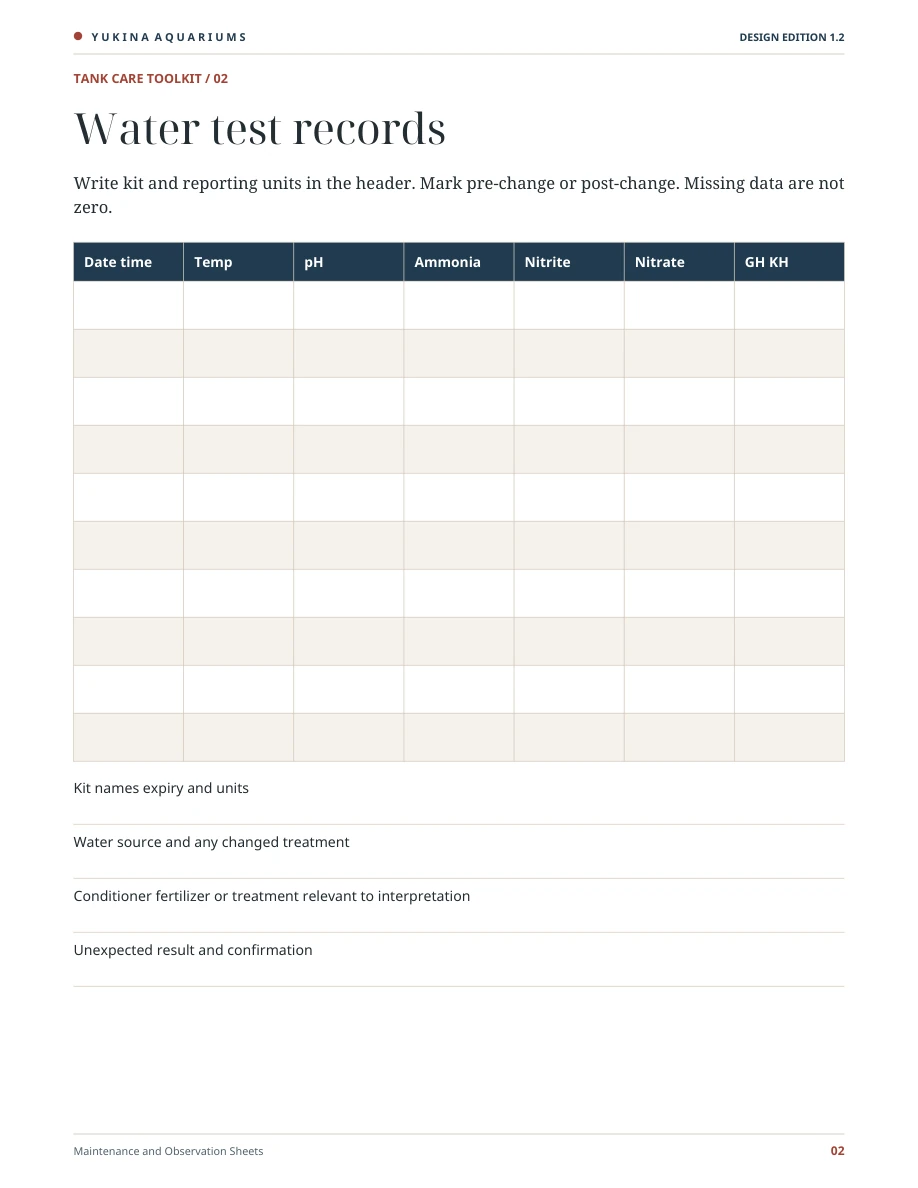
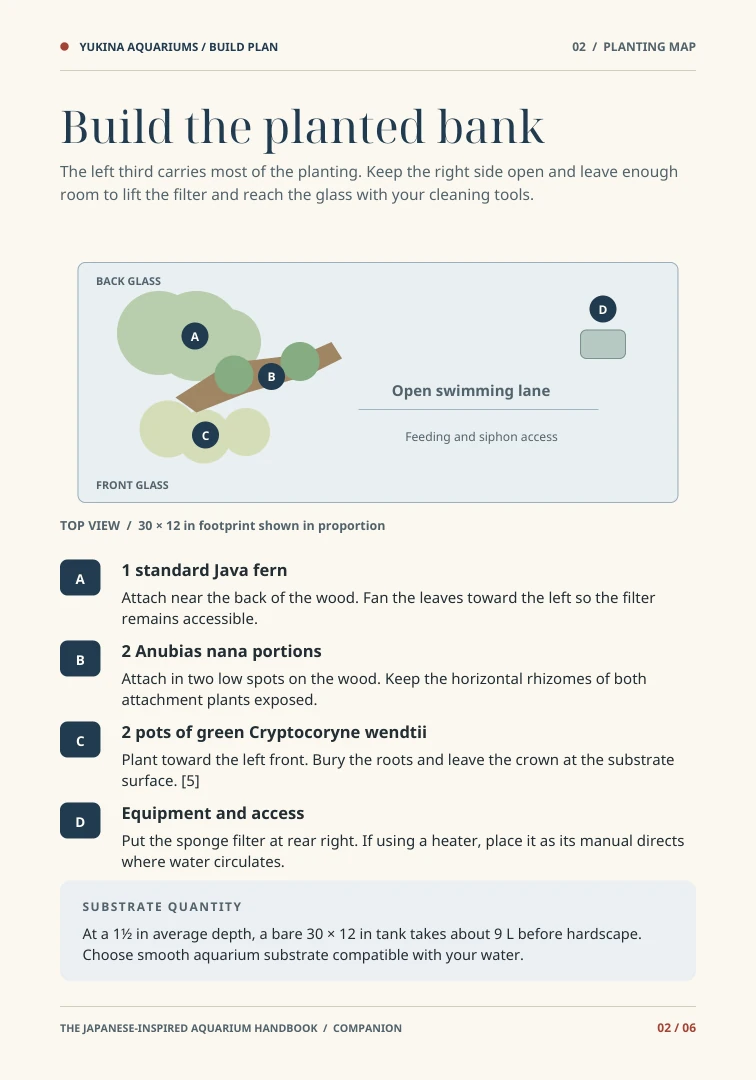
Actual planting map from the included build plan Actual water-test record worksheet
The Japanese-Inspired Aquarium Handbook by Yukina Aquariums, expanded edition 3.0
03REFERENCE / PROJECT / ROUTINEMade to keep
beside the tank.
386pages in the handbook
45practical methods
18focused chapters
36fish & plant profiles

01 / A CLEARER STARTING POINT

There’s plenty of aquarium advice.
A clear next step is harder to find.

The water looks different. The plants aren’t settling in. You’ve read three explanations, and each one recommends another product.

A useful reference helps you work out what matters in your tank. This handbook brings the explanation, practical steps, and limits of an approach together—so you can make a considered decision before reaching for your wallet.

01

Understand what you’re seeing.

Start with the nitrogen cycle, reliable tests, and the actual volume of water you’re caring for.

02

Choose a change with a purpose.

Explore filter care, planting, algae, and maintenance with the reasoning beside the instructions.

03

Keep a record worth returning to.

Use the companion sheets to connect a change with the observations that follow.
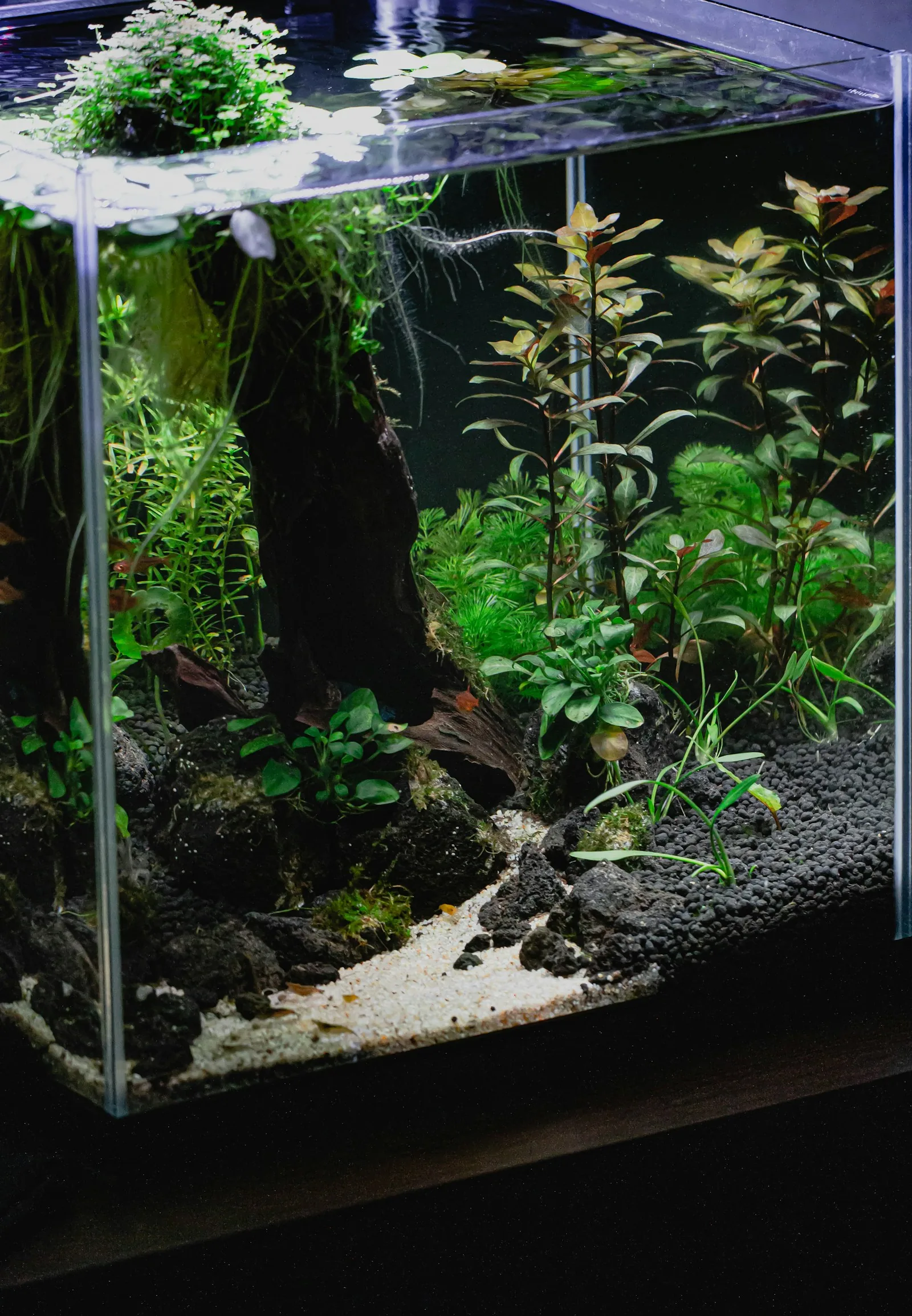
Live aquatic plants, driftwood and a pale substrate path in a freshwater aquarium

A MORE THOUGHTFUL HOBBY

Spend more time
enjoying the view.

AQUARIUM INSPIRATION · PHOTOGRAPHY BY CHRISTIAN ANGIllustrative setting; not a result documented by the handbook.
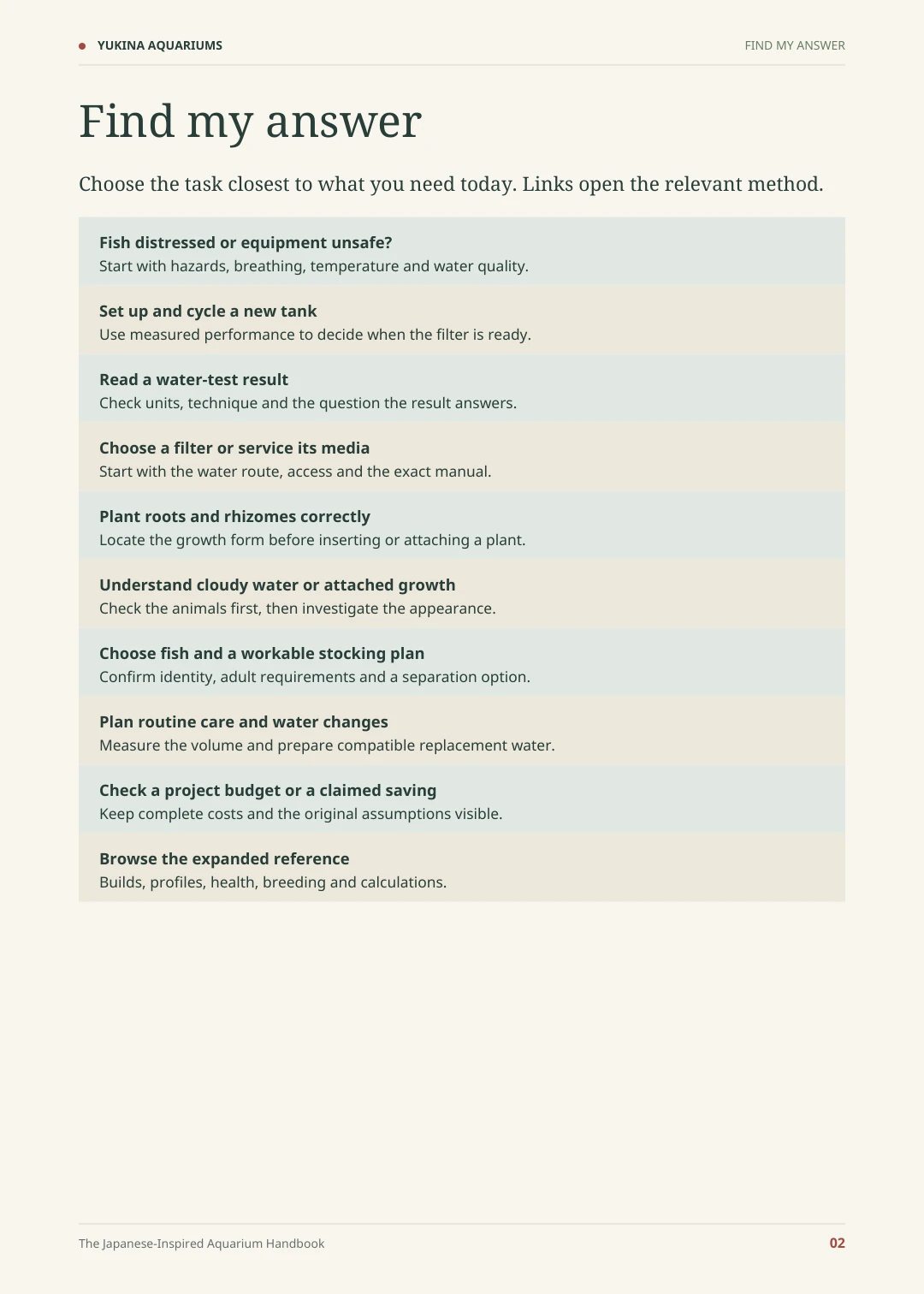
Actual Find my answer page with links for setting up, solving a problem, or deciding what to buy
ACTUAL PAGE 02 / THE HANDBOOK

02 / BUILT AROUND THE QUESTION IN FRONT OF YOU

You don’t have to read it
all at once.

Open “Find my answer” for the task in front of you, or choose a reading route through the methods, builds, profiles, and troubleshooting guides.

New to fishkeeping? Begin with the foundations. Already caring for a tank? Use the book as a reference when something changes.

  1. 01

    Observe before acting

    Establish what’s happening and record a useful baseline.

  2. 02

    Understand the method

    See the preparation, steps, decisions, and limits for the task.

  3. 03

    Follow up with evidence

    Use the worksheets to note what changed and what happened next.

Explore all 18 chapters

03 / THE MAIN HANDBOOK

A reference with
room for the details.

386 pages bring the foundations, worked cases, complete builds, and everyday reference guides together in one searchable PDF.
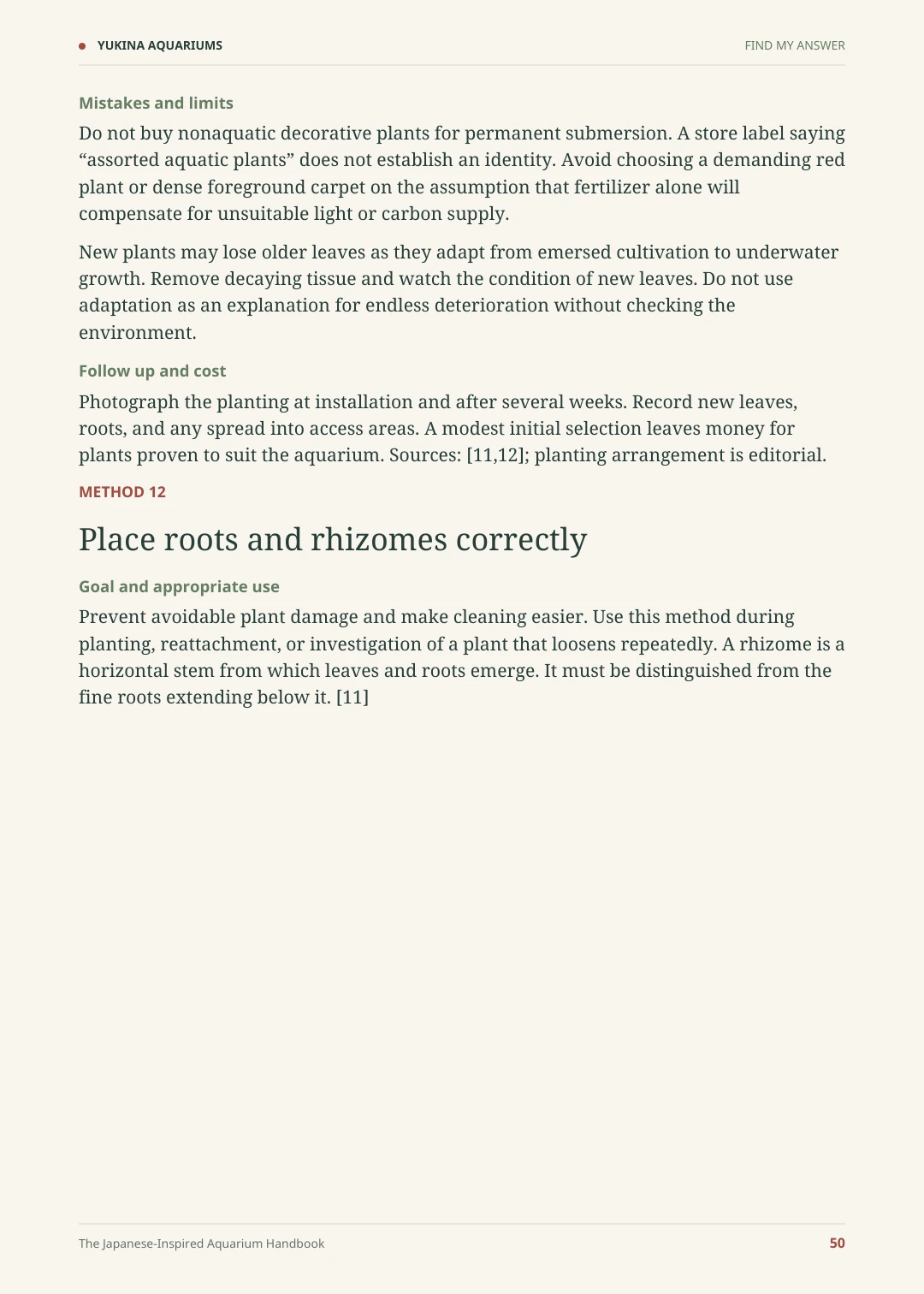
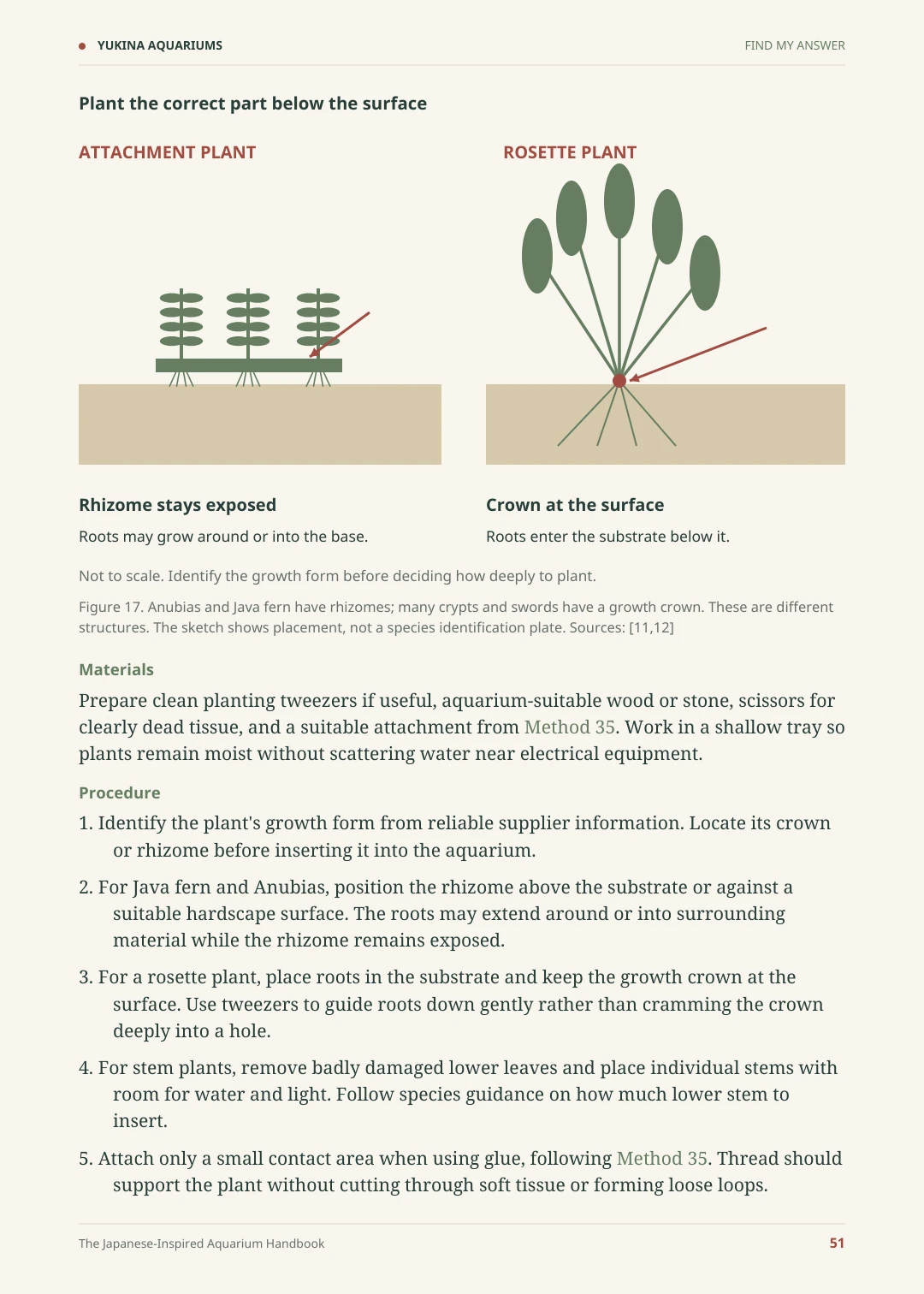
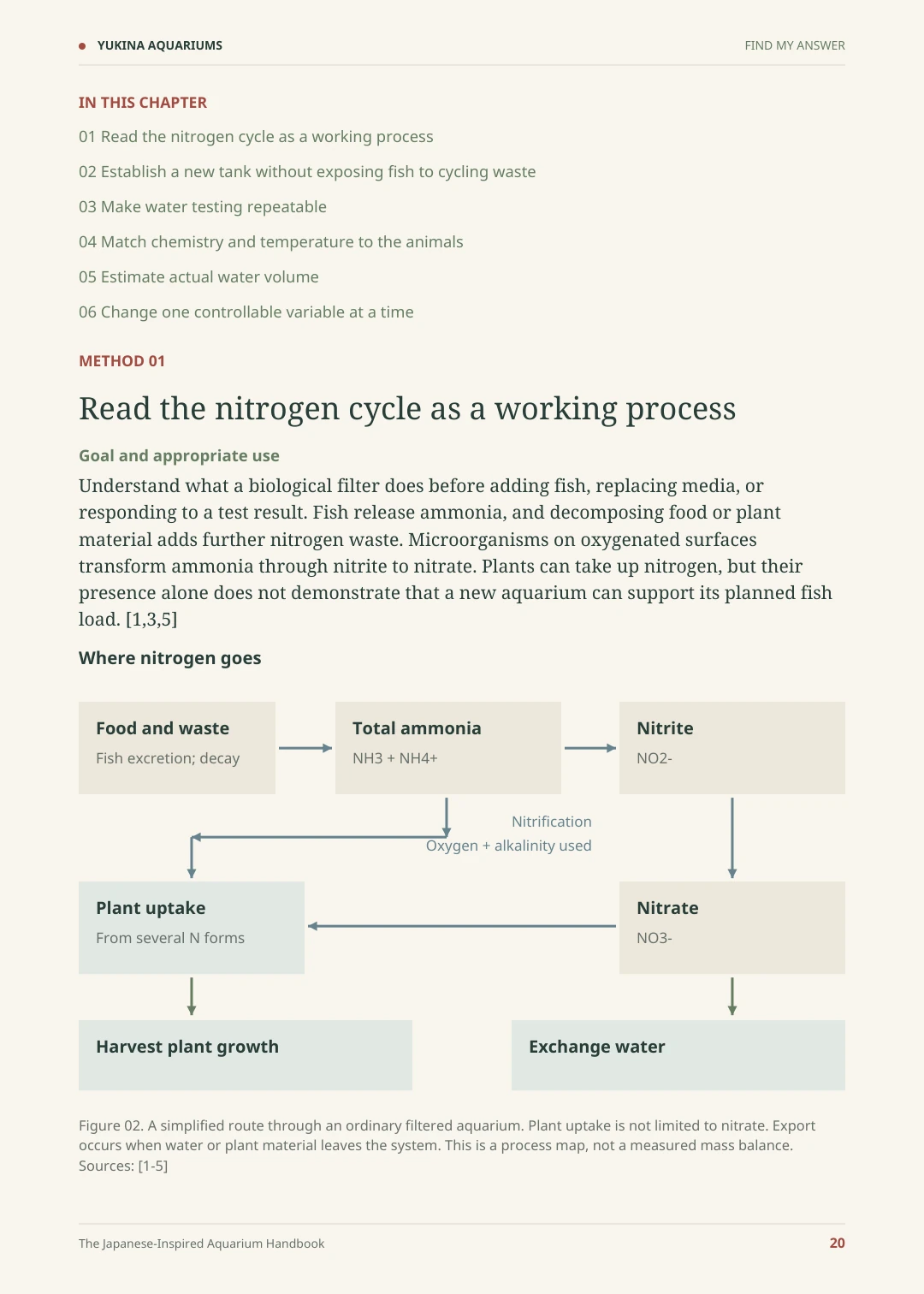
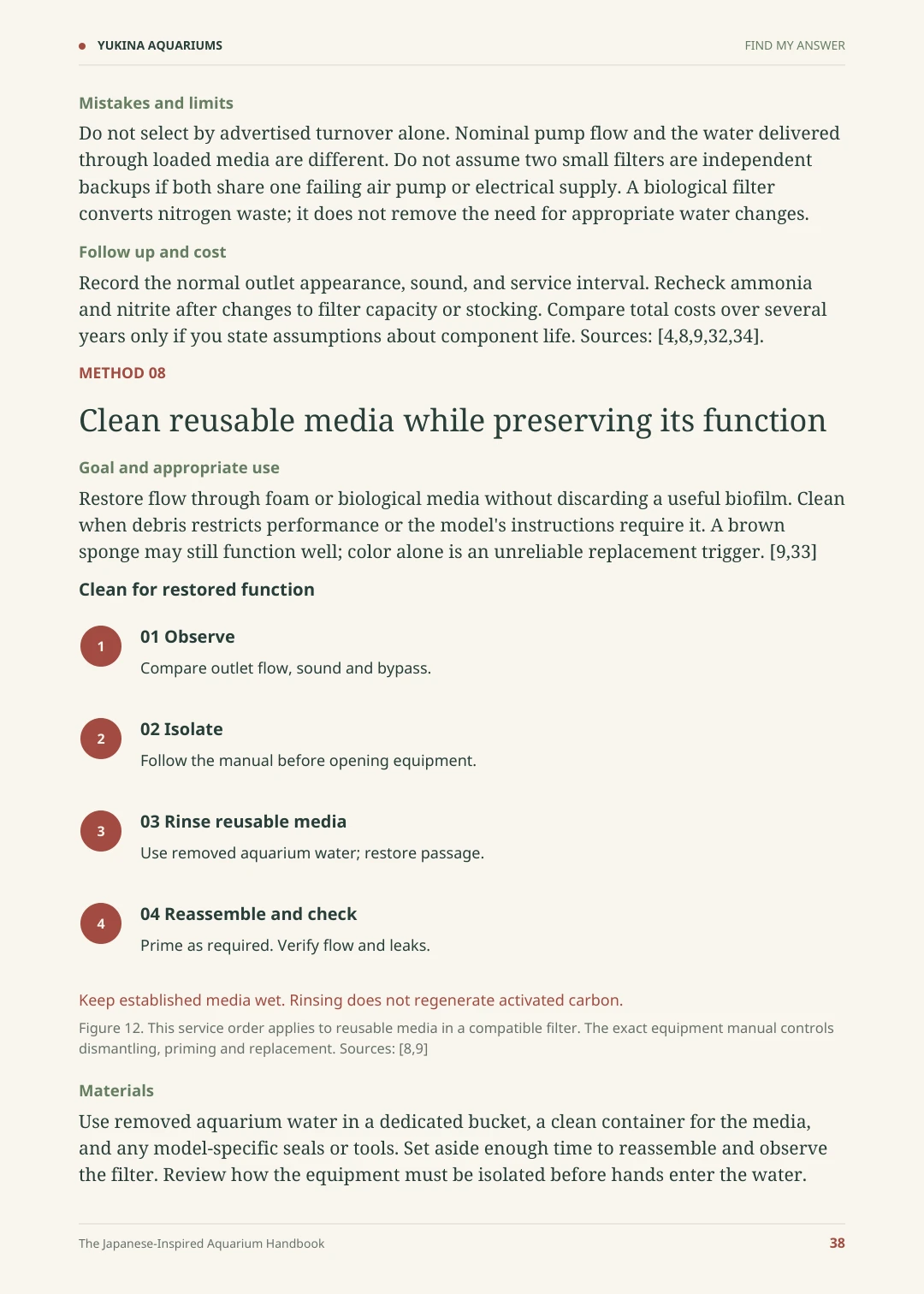
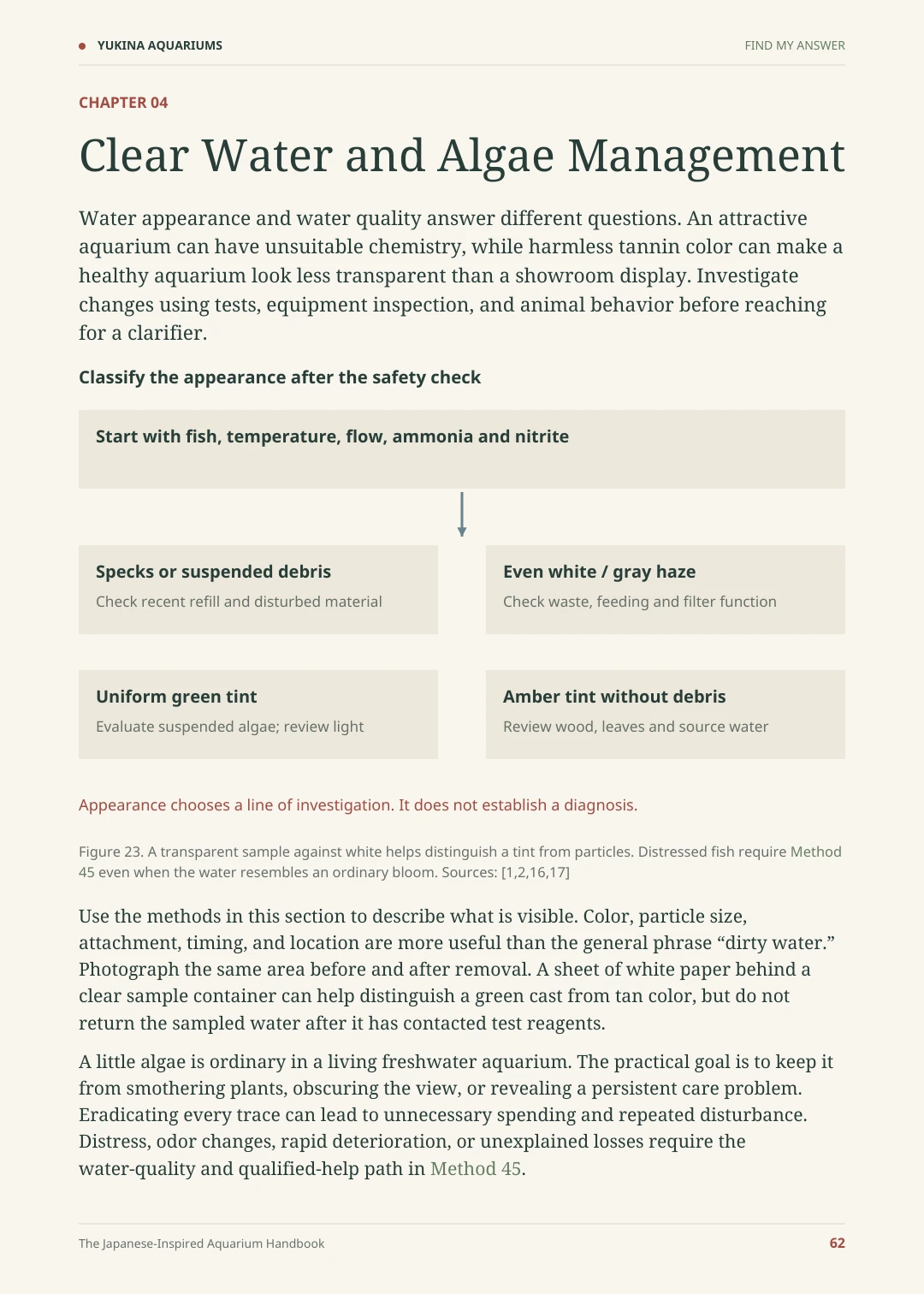
Actual expanded-edition page 50: plant choices and rhizome placementActual expanded-edition page 51: attachment plants and rosette crowns
ACTUAL EXPANDED EDITION / PAGES 50–51

EXPANDED EDITION 3.0

The Japanese-Inspired
Aquarium Handbook

Keep the “why” beside the “how.” Read a complete method, follow a worked example, then use a build or reference profile to plan your next decision.

  • 54 credited photographs and original technical diagrams
  • 45 methods, each with a practical guide and worked case
  • Common mistakes, limits, and follow-up decisions
  • References to the published sources behind the guidance

Searchable PDF with linked contents, two navigation pages, and 297 bookmarks. Read on a phone, tablet, or computer.

See the pages for yourself

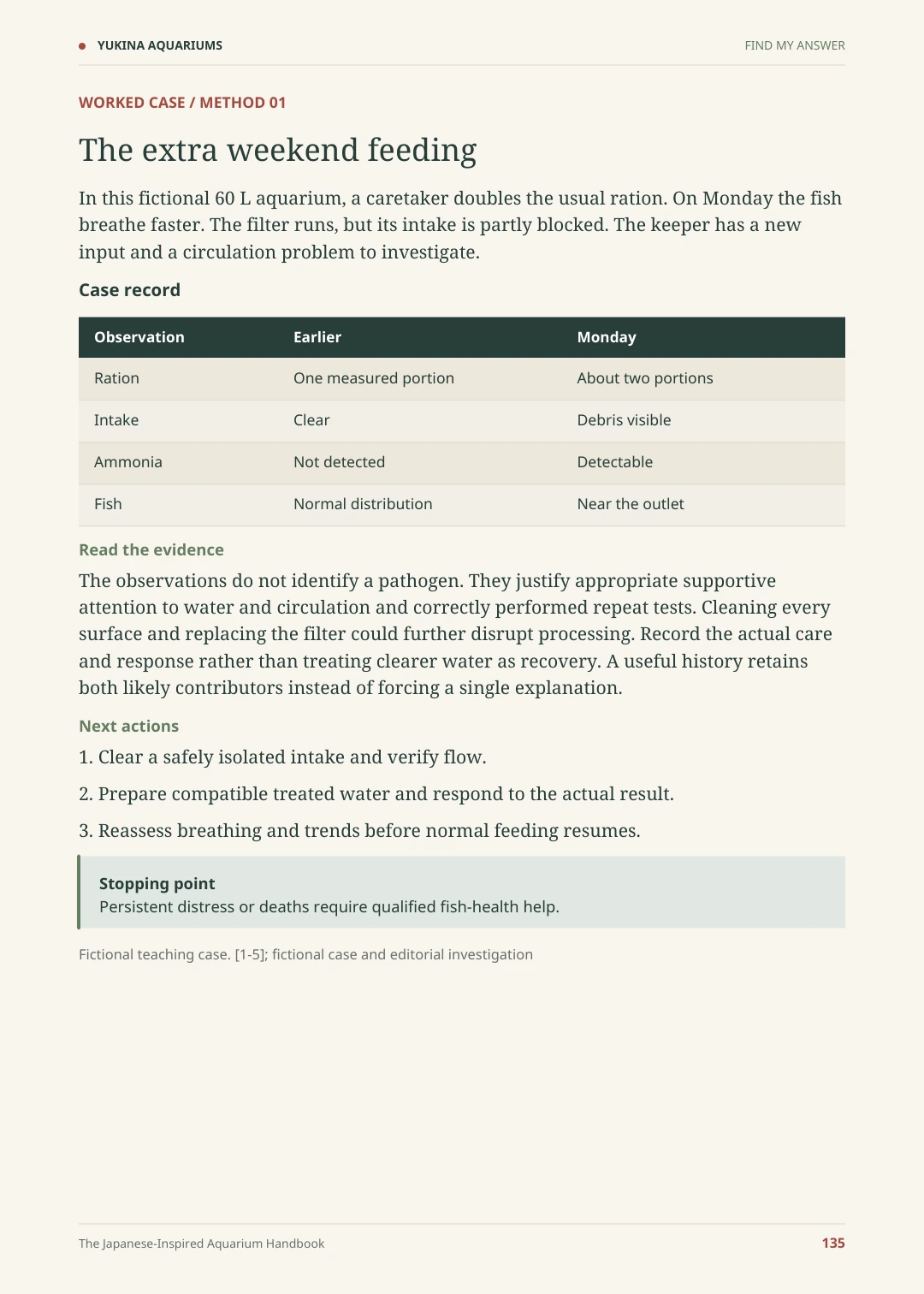
45 WORKED CASES

See a method in context.

Read the observations, consider the evidence, and follow the next actions in a fictional aquarium case. Every original method has its own practical guide and case.

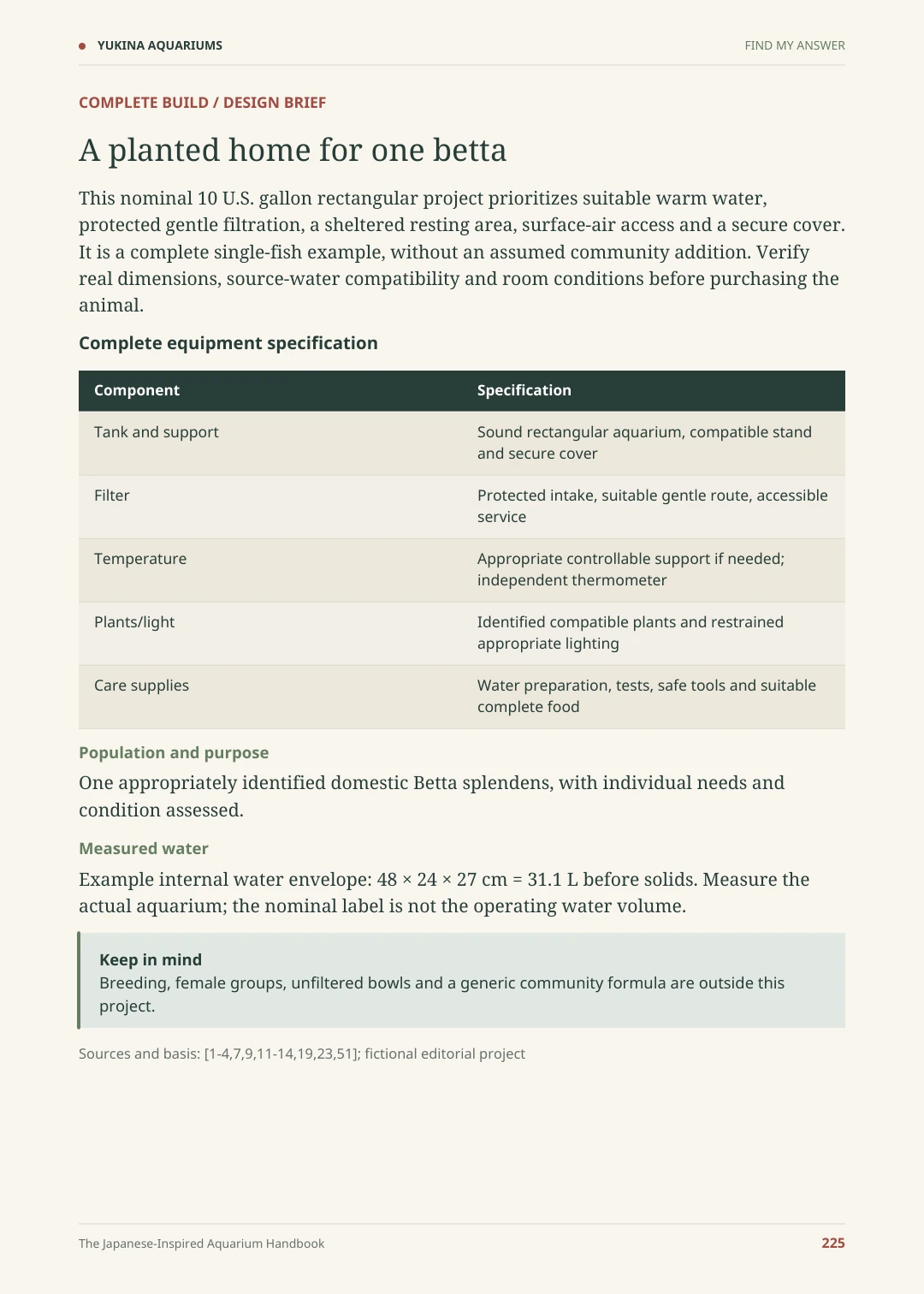
8 COMPLETE BUILDS

Plan the whole aquarium.

Work through a betta setup, rasboras, corys, shrimp, and more. Each four-page project connects equipment, layout, establishment, and a follow-up example.

24 FISH + 12 PLANT PROFILES

Look closer before buying.

Use real photographs and focused planning notes to consider habitat, feeding, compatibility, and plant placement before adding to your tank.

20 TROUBLESHOOTING PATHS

Work through the next question.

Investigate water, equipment, algae, and plant problems. Separate health and nursery sections help you prepare records, care, and the right questions.

05 / THE CONTENTS

From the first water test
to a routine that makes sense.

Eighteen chapters take you from the original methods into practice, complete builds, profiles, health, breeding, and focused reference guides. Open a chapter to see what it covers.

45 METHODS / 18 CHAPTERS
01Understand the Aquarium Before Changing ItMETHODS 01–06 / 6 METHODS
  1. 01Read the nitrogen cycle as a working process
  2. 02Establish a new tank without exposing fish to cycling waste
  3. 03Make water testing repeatable
  4. 04Match chemistry and temperature to the animals
  5. 05Estimate actual water volume
  6. 06Change one controllable variable at a time
02Filtration Without Unnecessary SpendingMETHODS 07–10 / 4 METHODS
  1. 07Select a filter by the work it must do
  2. 08Clean reusable media while preserving its function
  3. 09Decide whether a cartridge or chemical medium needs replacement
  4. 10Manage flow without defeating the equipment
03Achievable Planted AquariumsMETHODS 11–16 / 6 METHODS
  1. 11Select a small plant palette by growth form
  2. 12Place roots and rhizomes correctly
  3. 13Set a restrained light period and adjust from evidence
  4. 14Choose substrate for the planting and water
  5. 15Fertilize according to the product and the observed growth
  6. 16Compose and propagate a layout that remains accessible
04Clear Water and Algae ManagementMETHODS 17–20 / 4 METHODS
  1. 17Identify the likely category of cloudiness
  2. 18Describe attached algae before choosing removal
  3. 19Reduce recurring algae with a documented sequence
  4. 20Decide whether livestock or UV serves a real purpose
05Choose Fish That Fit the AquariumMETHODS 21–24 / 4 METHODS
  1. 21Create a species requirements card
  2. 22Design stocking around a footprint and a care routine
  3. 23Purchase and introduce livestock with a quarantine plan
  4. 24Watch compatibility after the purchase
06Feeding and Everyday ObservationMETHODS 25–28 / 4 METHODS
  1. 25Build a diet around the fish rather than the package image
  2. 26Calibrate a portion by watching consumption
  3. 27Use supplements and a small live-food culture deliberately
  4. 28Prepare vacation feeding and a useful daily check
07A Manageable Maintenance SystemMETHODS 29–33 / 5 METHODS
  1. 29Choose a water-change amount from measurements
  2. 30Clean substrate selectively
  3. 31Coordinate filter plant and equipment care
  4. 32Keep a record that changes the next decision
  5. 33Move an aquarium while protecting fish and filtration
08Budget Projects and MaterialsMETHODS 34–38 / 5 METHODS
  1. 34Make a removable feeding station
  2. 35Attach an aquarium plant with a specified adhesive
  3. 36Assemble a dedicated precision cleaning kit
  4. 37Support emergent planting without crowding the aquarium
  5. 38Organize equipment and decide which substitutions are worthwhile
09Japanese Inspired Container Ponds and Small Water GardensMETHODS 39–42 / 4 METHODS
  1. 39Select a container and site for a measured trial
  2. 40Plant the water garden and preserve oxygen access
  3. 41Decide whether medaka belong in the project
  4. 42Prepare for heat rain predators mosquitoes and winter
10Spend Deliberately and Solve Problems MethodicallyMETHODS 43–45 / 3 METHODS
  1. 43Prioritize essentials and build a complete project budget
  2. 44Calculate savings without counting the same benefit twice
  3. 45Troubleshoot in an order that protects the aquarium
11Practice the 45 Methods45 GUIDES + 45 FICTIONAL CASES
  1. 0145 practical guides linked to the complete methods
  2. 0245 fictional worked cases with observations and next actions
  3. 03Water, equipment, plants, livestock, routines, and project decisions
  4. 04Source notes, stopping points, and follow-up questions
12Eight Complete Aquarium Builds8 FOUR-PAGE BUILD PLANS
  1. 01A planted home for one betta
  2. 02A 20-long rasbora aquarium
  3. 03A floor-focused bronze cory aquarium
  4. 04A 40-breeder planted community
  5. 05A monitored cooler-water minnow setup
  6. 06A dedicated cherry-shrimp aquarium
  7. 07An independent observation aquarium
  8. 08A fish-free container water garden
13Fish and Invertebrate Planning Profiles24 PLANNING PROFILES
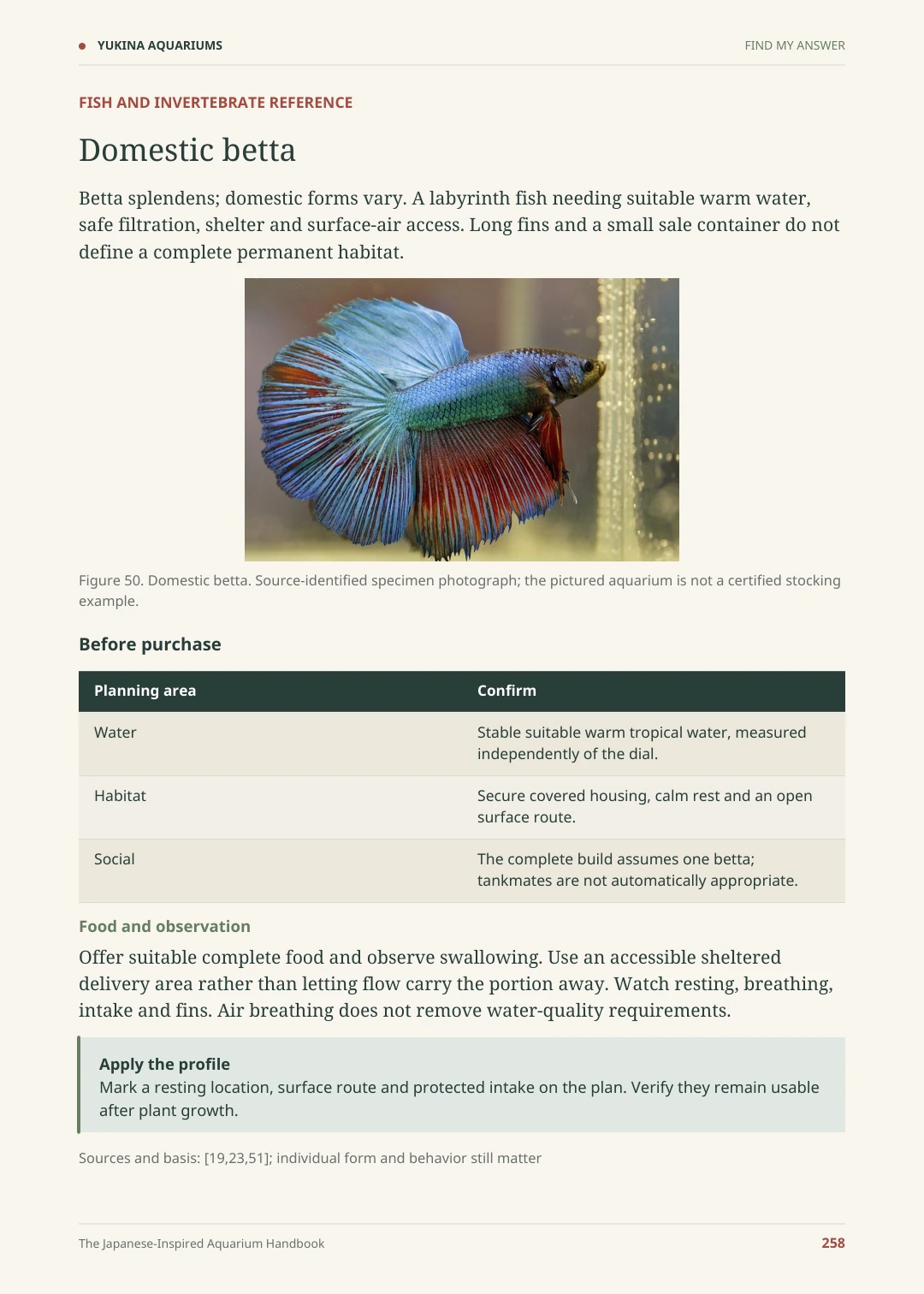
  1. 01Domestic betta
  2. 02Neon tetra
  3. 03Harlequin rasbora
  4. 04Zebra danio
  5. 05White-cloud mountain minnow
  6. 06Japanese ricefish / medaka
  7. 07Guppy
  8. 08Platy
  9. 09Molly
  10. 10Swordtail
  11. 11Cherry barb
  12. 12Tiger barb
  13. 13Bronze cory
  14. 14Pygmy cory
  15. 15Bristlenose-type Ancistrus
  16. 16Otocinclus-type catfish
  17. 17Banded kuhli-type loach
  18. 18Honey gourami
  19. 19Pearl gourami
  20. 20Freshwater angelfish
  21. 21Fancy goldfish
  22. 22Cherry shrimp
  23. 23Amano shrimp
  24. 24Zebra-type nerite snail
14Twelve Plant Growth Profiles12 GROWTH & PLACEMENT PROFILES
  1. 01Anubias
  2. 02Java fern
  3. 03Cryptocoryne wendtii
  4. 04Vallisneria
  5. 05Amazon sword type
  6. 06Water wisteria
  7. 07Bacopa caroliniana
  8. 08Ludwigia repens group
  9. 09Java moss
  10. 10Salvinia minima
  11. 11Amazon frogbit
  12. 12Dwarf sagittaria type
15Fish Health: Observe, Support, Refer16 OBSERVATION & CARE GUIDES
  1. 01Build a normal-behavior baseline
  2. 02Respond to abnormal breathing
  3. 03Record white spots without guessing
  4. 04Track a damaged fin margin
  5. 05Describe cotton-like material precisely
  6. 06Assess swelling as a sign
  7. 07Investigate loss of balance
  8. 08Interpret repeated rubbing or flashing
  9. 09Work through loss of appetite
  10. 10Audit the quarantine route
  11. 11Prepare a receiving record
  12. 12Make treatment reviewable
  13. 13Follow through after early improvement
  14. 14Contact a diagnostic service effectively
  15. 15Preserve history after a death
  16. 16Protect people during care
16Breeding and Nursery Preparation16 BREEDING & NURSERY GUIDES
  1. 01Decide whether to breed at all
  2. 02Identify the reproductive mode
  3. 03Prepare healthy adult stock
  4. 04Confirm sex and parentage carefully
  5. 05Design a nursery for the smallest stage
  6. 06Prepare first food before it is needed
  7. 07Plan for livebearer young
  8. 08Keep a medaka egg and nursery record
  9. 09Prepare an egg-scattering project
  10. 10Plan an attached-egg cory project
  11. 11Respect bubble-nest and parental behavior
  12. 12Prepare cave-spawning catfish care
  13. 13Feed growing young without hiding waste
  14. 14Measure growth and capacity honestly
  15. 15Keep nursery exposure routes clear
  16. 16Rehome with an honest care handover
17Twenty Troubleshooting Paths20 FOCUSED TROUBLESHOOTING PATHS
  1. 01Ammonia after new stock
  2. 02Nitrite in an established tank
  3. 03Nitrate barely changes after care
  4. 04pH differs through the day
  5. 05Alkalinity falls between changes
  6. 06Heater dial and thermometer disagree
  7. 07Warm weather overheats the water
  8. 08The motor runs but water does not move
  9. 09Water bypasses the media
  10. 10Bubbles appear at the return
  11. 11An unusual odor develops
  12. 12The water turns green
  13. 13Brown dusting returns on surfaces
  14. 14Long strands spread through plants
  15. 15A mat or sheet-like film appears
  16. 16Leaves deteriorate after planting
  17. 17Plant growth stays slow
  18. 18Small snails become more visible
  19. 19Shrimp deteriorate after routine care
  20. 20Recover after a power interruption
18Calculations and Practical References16 CALCULATION & REFERENCE GUIDES
  1. 01Calculate a defensible water envelope
  2. 02Keep conversions explicit
  3. 03Translate a planned change into litres
  4. 04Predict a simple mixed concentration
  5. 05Understand repeated partial changes
  6. 06Use temperature mixing as a rough model
  7. 07Calculate electricity from operating time
  8. 08Keep annual and initial cost separate
  9. 09Calculate simple payback
  10. 10Interpret measured flow carefully
  11. 11Report useful ranges
  12. 12Choose tests around decisions
  13. 13Schedule inspections with event triggers
  14. 14Ask purchase questions that matter
  15. 15Prepare a concise diagnostic handover
  16. 16Use a shared working vocabulary

06 / PUT THE IDEAS TO WORK

The book explains it.
The companions help you use it.

Alongside the eight builds inside the handbook, the bundle includes a separate six-page planted-tank plan and five practical tools for everyday use.
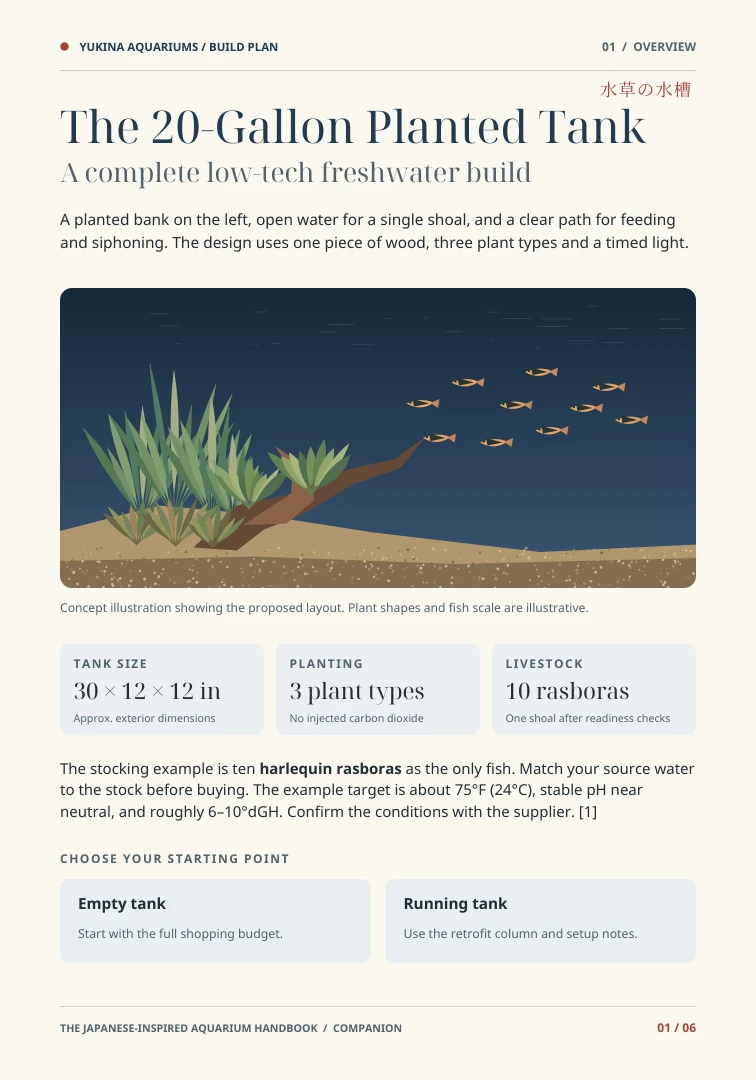
Actual first page of the six-page 20-Gallon Planted Tank Build with its concept illustrationThe included planting mapACTUAL BUILD PLAN / PAGES 01–02

INCLUDED COMPANION / 6 PAGES

The 20-Gallon
Planted Tank Build

Follow the decisions for one complete low-tech freshwater layout, from the shopping list to the planting map and ongoing care.

  • Full setup and existing-tank retrofit budgets
  • Plant placement and space for maintenance
  • Setup sequence and readiness checks
  • A care routine and personal planning record
30 × 12 in footprint3 plant typesNo injected CO₂

A worked design example, with a concept illustration. Match livestock and equipment choices to your conditions.

Explore the actual planting map
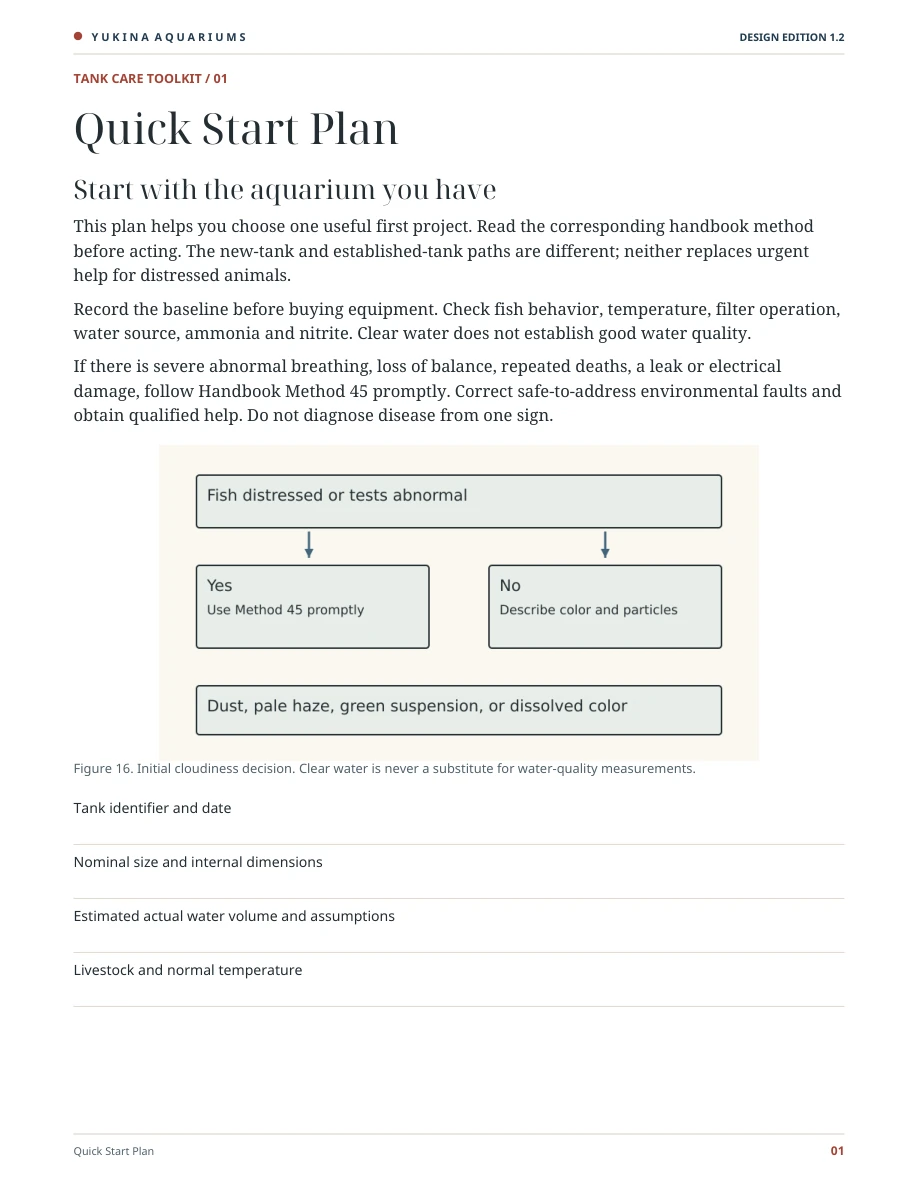
Actual Quick Start Plan first page

TOOL 01 / 5-PAGE PDF

Quick Start Plan

Choose a useful first project with separate paths for a new aquarium and an established one. Write down the baseline before changing the setup.

USE IT WHEN / You need a sensible place to begin.
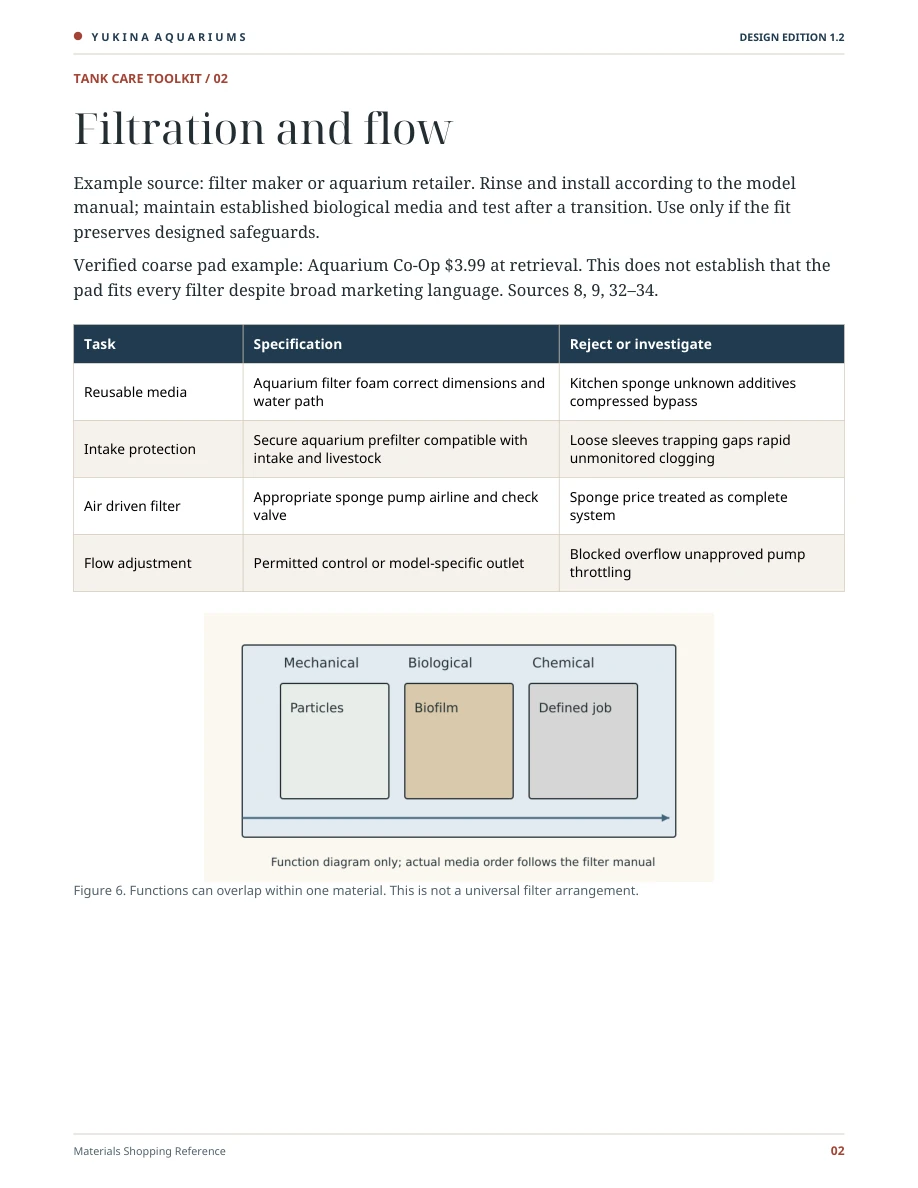
Actual Materials Shopping Reference filtration table

TOOL 02 / 5-PAGE PDF

Materials Shopping Reference

Start with a specification before a product name. Review material suitability, filter media, plant attachments, cleaning tools, and outdoor containers.

USE IT WHEN / You’re deciding what belongs on the list.
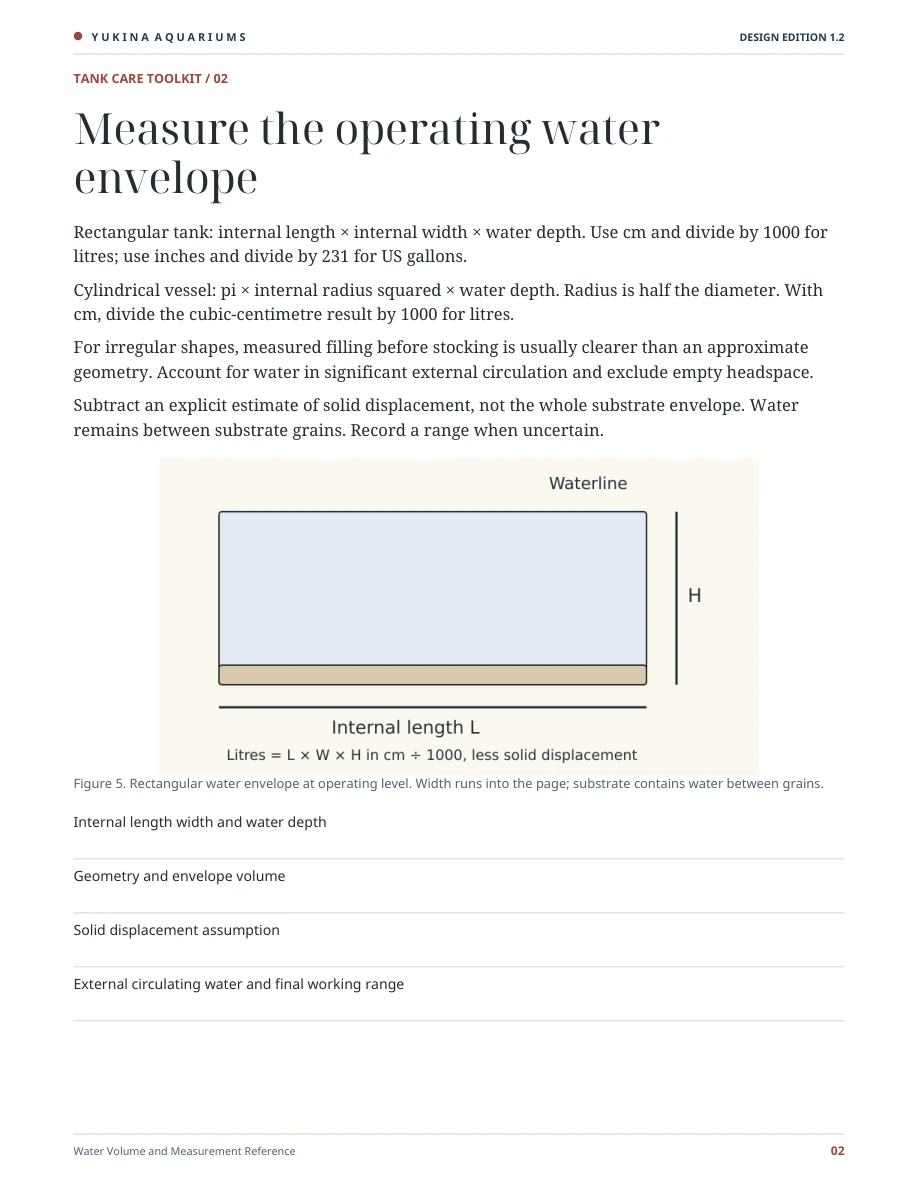
Actual water-volume measurement diagram and calculation notes

TOOL 03 / 4-PAGE PDF

Water Volume & Measurement

Keep conversions, working-volume calculations, and measurement examples within reach. Record the assumptions behind the number.

USE IT WHEN / The tank label isn’t the water volume.
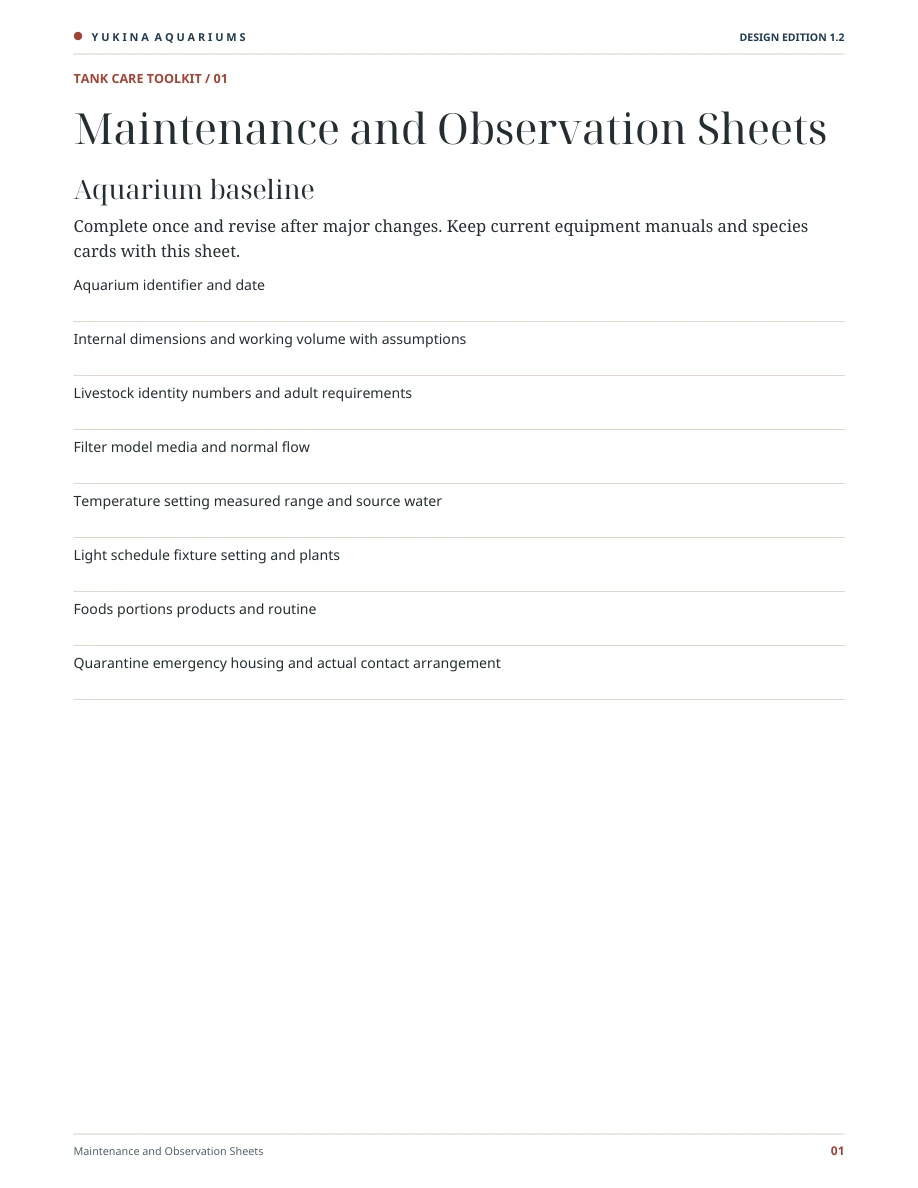
Actual aquarium baseline worksheet from the observation sheets

TOOL 04 / 8-PAGE PDF

Maintenance & Observation Sheets

Track water tests, equipment, feeding, plant growth, livestock, and follow-up observations. Build a record that helps with the next decision.

USE IT WHEN / You want more than a list of numbers.
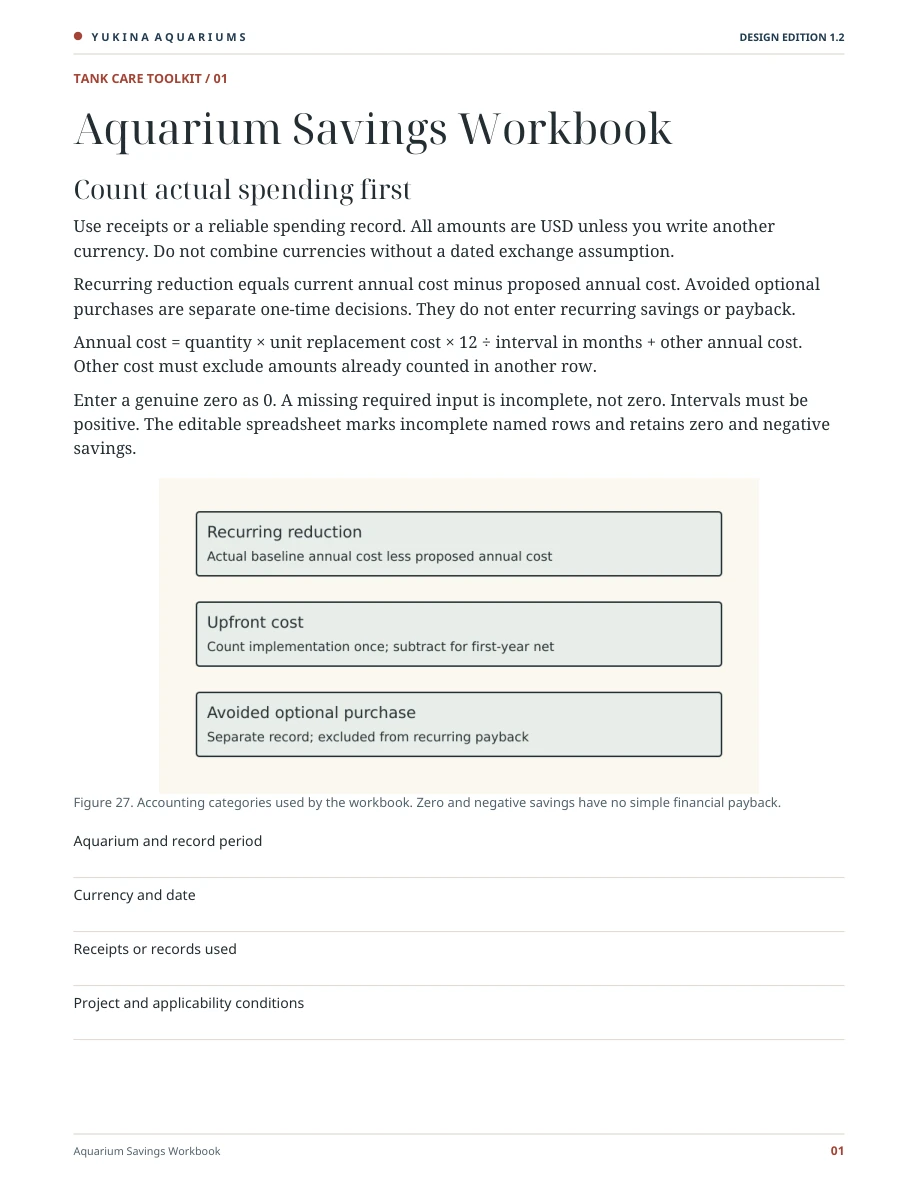
Actual printable Aquarium Savings Workbook first pagePDF + XLSX

TOOL 05 / 4-PAGE PDF + EDITABLE WORKBOOK

Aquarium Savings Workbook

Compare the purchases you actually make. Separate recurring costs, one-time equipment spending, and optional purchases you decide to skip.

The editable spreadsheet includes Savings, Avoided purchases, Examples, and Equipment tabs. A printable version is included for pen-and-paper planning.

USE IT WHEN / You want your own numbers, with no promised savings.

07 / MADE FOR THE WAY YOU KEEP FISH

A useful place
to come back to.

For freshwater keepers who want to understand the system they care for.

Starting your first aquarium

Get an ordered foundation for cycling, water testing, livestock planning, and the equipment decisions that come first.

Working with the tank you already have

Find a relevant method without rebuilding a stable setup or piecing the explanation together from a dozen tabs.

Planning a planted tank or a better routine

Use the worked build and companion records to connect your layout, shopping, and day-to-day care.

Written for freshwater aquariums and small container water gardens. It does not cover reef keeping or replace qualified veterinary care.

08 / ONE COMPLETE DIGITAL COLLECTION

The reference. The project.
The pages you’ll put to work.

The expanded 386-page handbook, a separate planted-tank companion, and practical tools to make the details your own.

Water-test worksheet included in the bundlePlanted-tank build included in the bundle
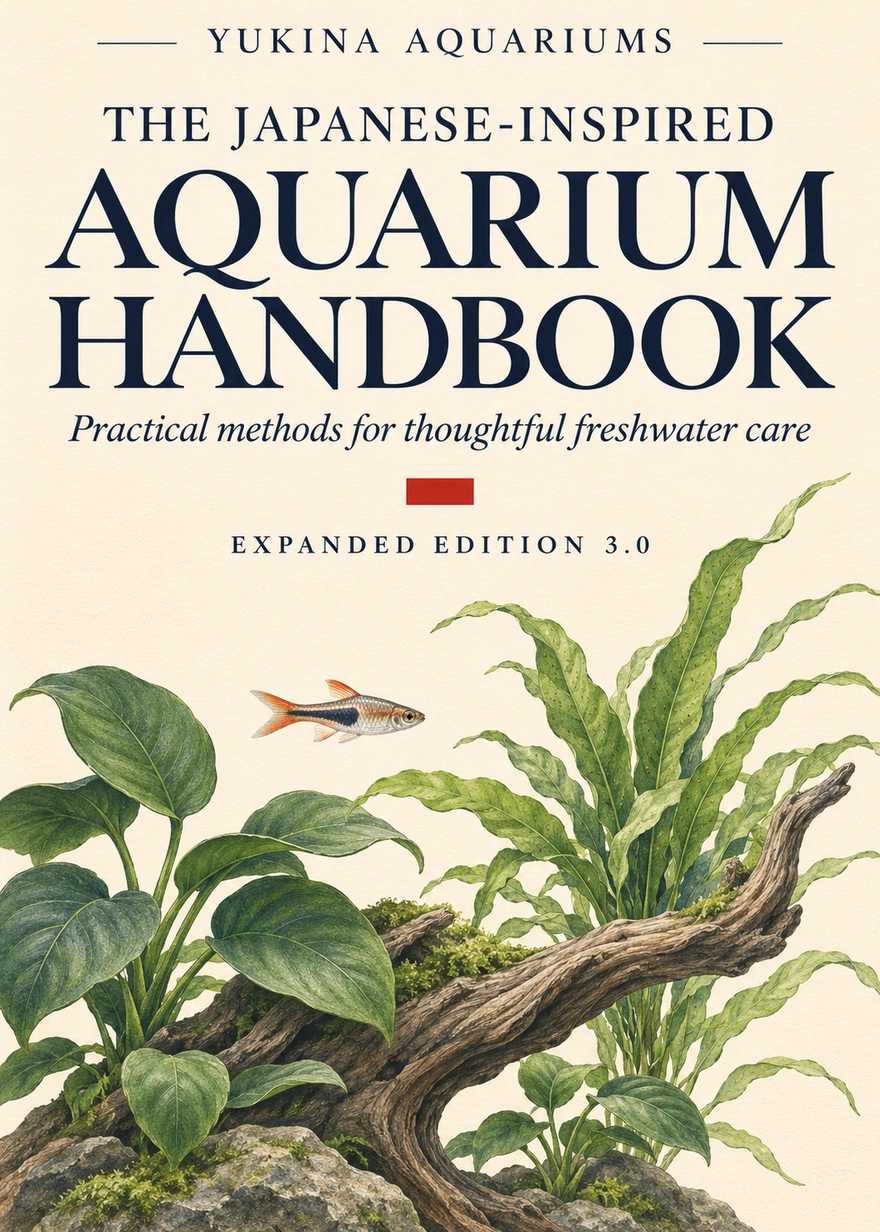
The actual expanded edition 3.0 handbook cover
Savings workbook included in the bundle
7 PDFs418 pages across the collection1 workbookEditable XLSX spreadsheet

THE COMPLETE BUNDLE / EDITION 3.0

The Japanese-Inspired
Aquarium Handbook

  • Expanded handbook · 18 chapters386 pages
  • The 20-Gallon Planted Tank Build6 pages
  • Quick Start Plan5 pages
  • Materials Shopping Reference5 pages
  • Water Volume & Measurement4 pages
  • Maintenance & Observation Sheets8 pages
  • Aquarium Savings WorkbookPDF + XLSX
$20USD

One payment.
No subscription.

Get the complete bundle

Continue to secure Payhip checkout.

Digital files only. No physical book or equipment. Any applicable tax is confirmed at checkout.

09 / BEFORE YOU BEGIN

A few practical
questions.

The details you should know before choosing the handbook.

Revisit the sample pages
What exactly will I receive?

The 386-page expanded handbook, the separate six-page 20-Gallon Planted Tank Build, and five companion tools. There are seven PDFs totaling 418 pages, plus an editable XLSX savings workbook. The handbook is expanded edition 3.0; the companion files are the existing resources listed above.

What’s new in the expanded edition?

All 45 original methods remain. The expanded handbook adds 45 practical guides and 45 fictional worked cases, eight complete builds, 24 fish and invertebrate profiles, 12 plant profiles, and dedicated health, breeding, troubleshooting, and calculation sections. The book now has 18 chapters and 54 source-credited photographs.

Is it suitable for a beginner?

Yes. Start with the chapter on understanding the aquarium and use the Quick Start Plan’s new-tank path. It covers the foundations before moving into individual decisions.

Will it help with an aquarium I already own?

The handbook includes maintenance, filter care, algae, plant placement, feeding, and stocking decisions. Use “Find my answer” to reach a relevant method, and record your baseline before making a change.

Do I need expensive equipment or injected CO₂?

The included 20-gallon project is a low-tech planted example without injected carbon dioxide. The handbook helps you judge equipment by its purpose and suitability. The right setup still depends on your livestock, plants, and conditions.

Is this a printed book?

No. This is a digital collection. Read the searchable PDFs on a phone, tablet, or computer, and print the worksheets if you prefer. The XLSX workbook opens in compatible spreadsheet software; a printable PDF version is also included.

How will the download work?

Purchases are handled by Payhip, which provides a download page and an email receipt with a download link after a completed purchase. Keep your receipt so you can return to your files.

Does it promise a specific result or saving?

No fixed savings, maintenance-free tanks, or livestock outcomes are promised. The workbook helps you compare your actual costs. The methods include limits because different aquariums need different decisions.

What does “Japanese-inspired” mean here?

It describes the collection’s restrained visual design and its interest in considered layouts and small water gardens. The guidance draws on published sources and standard freshwater husbandry principles; it does not claim a single Japanese method fits every aquarium.

Are future editions included?

This offer is for the current expanded edition 3.0 and the files listed above. Future editions or extra resources are not promised as part of this purchase.

A REFERENCE FOR THE NEXT QUESTION, TOO

Keep a clearer plan
beside your aquarium.

Explore the pages. Understand the approach.
Choose the complete digital collection for $20 USD.

Get the complete bundle · $20

Continue to secure Payhip checkout.

Page preview

THE COMPLETE DIGITAL BUNDLE

Checkout
unavailable.

The bundle is priced at $20 USD. Please use the Payhip product page to complete your purchase.

For order questions, use the Contact support link in the footer.

GOOD TO KNOW

Purchase
information.

The current collection is expanded edition 3.0: seven PDFs and one XLSX workbook. It is a digital product; no physical items ship.

Continue to secure Payhip checkout.

Payment and download delivery take place through Payhip. Review the seller’s contact details and applicable purchase terms at checkout. Keep the receipt for access to your downloads.

No subscription, fixed savings, or access to future editions is promised.

PRIVACY & IMAGE CREDITS

A quieter
website, too.

This page uses no analytics scripts, advertising trackers, forms, or cookies. Fonts and product preview images are served with the website. The hosting provider may process standard request logs.

If you follow a checkout link, Payhip and its payment providers handle the transaction under their own terms and privacy policies. This website does not collect card details.

Aquarium photograph by Christian Ang, used under the Unsplash License. It is inspiration photography, not a documented handbook result. The botanical cover is illustrative artwork created for Yukina Aquariums; it is not a photograph or a specimen-identification plate. The website uses the actual updated handbook cover. The book presentation is a mockup of digital files; no physical book is included. The betta preview uses ivabalk’s photograph, offered under CC0. Other product pages and diagrams come from the Yukina Aquariums collection.

Typography: Newsreader and DM Sans, distributed under the SIL Open Font License. The website design and copy are original.